


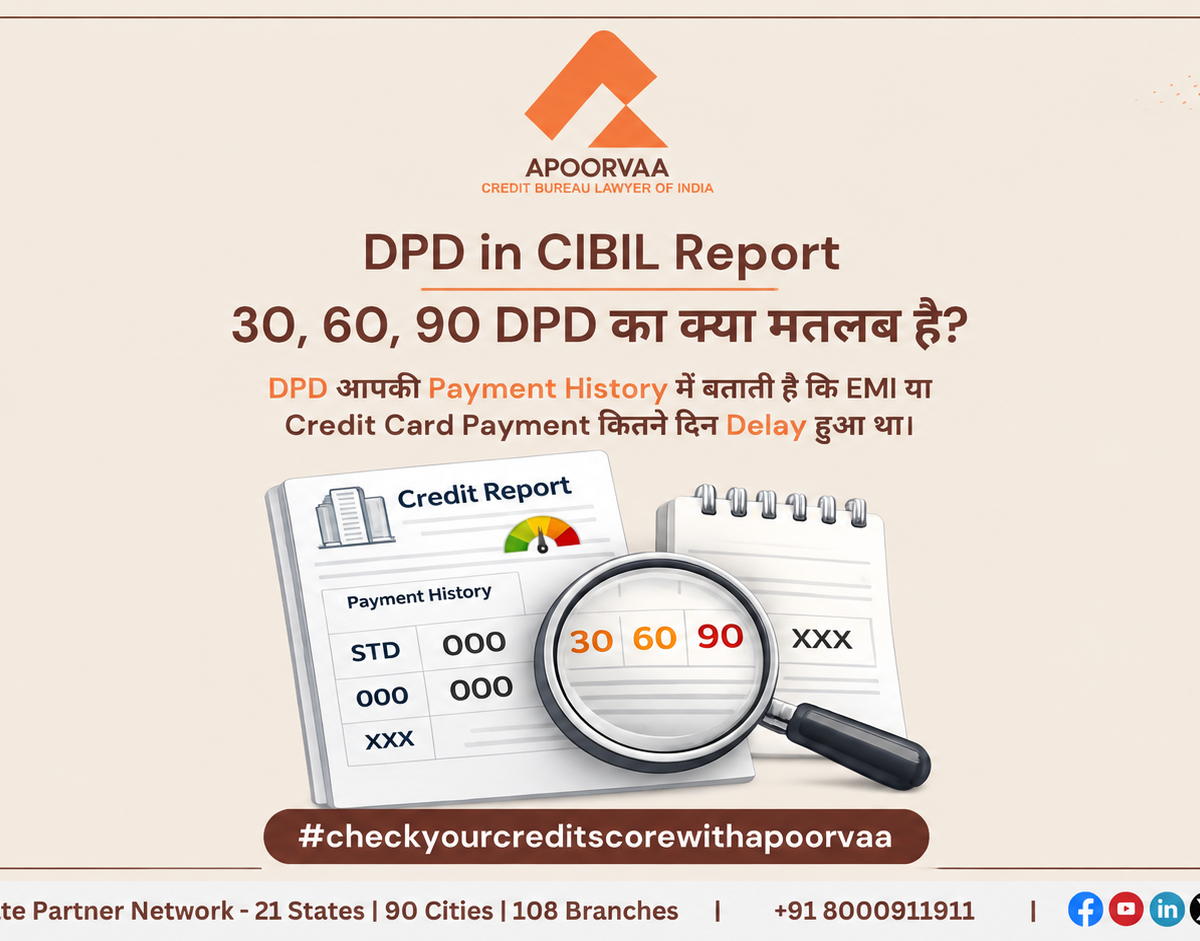
When reviewing a credit report, you may notice numbers such as 30, 60 or 90 appearing in the payment history of a loan or credit-card account. You may also come across codes such as 000, STD, XXX, SMA, SUB, DBT or LSS.
For someone reading a credit report for the first time, these entries can be confusing.
A common question is:
“What is DPD in CIBIL Report, and can an old DPD ever be removed?”
To answer this properly, it is important to first understand what DPD represents and why the month and year against which it appears matter.
What Is DPD?
DPD stands for Days Past Due.
It indicates the number of days by which a payment was overdue for a particular credit account during a reporting period.
For example, suppose you have a loan and the EMI is not paid according to the agreed repayment schedule.
Your payment history may show a numerical DPD depending on how long the payment remained overdue.
Therefore:
- 30 DPD indicates a payment reported approximately 30 days past due.
- 60 DPD indicates a longer payment delay.
- 90 DPD indicates an even longer period of delinquency.
Other numerical DPD values may also appear.
However, the number alone does not tell the complete story. You should also check which account, month and year the DPD relates to.
What Does 000 Mean?
000 generally indicates that there were no days past due for that particular reporting period.
Therefore, borrowers should not interpret 000 as a negative entry.
It normally indicates that the account was not reported as overdue for that period.
What Does STD Mean?
STD means Standard.
It generally indicates that the account was classified as standard during the relevant reporting period.
Some borrowers become worried because STD appears as letters rather than 000.
However, STD itself should not automatically be considered a negative delinquency.
What Does XXX Mean?
XXX generally indicates that payment-history information was not reported or was unavailable for that particular period.
It should not automatically be interpreted as a missed payment or default.
This is why understanding credit-report codes is important before drawing conclusions from them.
What Are SMA, SUB, DBT and LSS?
Apart from numerical DPD, the payment-history section may contain other classification codes.
These codes require more attention because they provide additional information about the reported condition or classification of the account.
SMA – Special Mention Account
SMA means Special Mention Account.
It is associated with accounts showing signs of repayment stress and is used within the regulatory framework to identify stressed accounts before or around the point at which they may become non-performing, depending on the applicable category and facility.
SUB – Sub-Standard
SUB means Sub-Standard.
This represents a more serious classification. Under RBI’s prudential framework, a sub-standard asset is an account that has remained an NPA for the prescribed period—generally up to 12 months under the relevant framework.
DBT – Doubtful
DBT means Doubtful.
A doubtful asset represents a further deterioration from the sub-standard classification. RBI describes a doubtful asset as one where the weaknesses make full collection or liquidation highly questionable or improbable based on the known circumstances.
LSS – Loss
LSS means Loss.
This is a serious asset classification. RBI describes a loss asset as one where loss has been identified and the asset is considered substantially uncollectible, although some recovery value may still exist.
Therefore, 000, STD, XXX, numerical DPD and asset-classification codes should not all be interpreted in the same way.
Can an Old DPD Be Removed?
This is where an important distinction needs to be understood.
Suppose you genuinely delayed an EMI by 90 days several years ago.
You later paid the outstanding amount and resolved the account.
Does that automatically mean the historical 90 DPD should become 000?
Not necessarily.
If the DPD accurately represents what happened during that particular month, paying the outstanding amount later does not change the historical fact that the payment had been delayed.
Resolving an outstanding liability and changing historical repayment information are two different things.
What If the DPD Is Incorrect?
An incorrectly reported DPD is a different situation.
For example, suppose your report shows 60 DPD for a particular month, but your bank statement and payment records establish that the EMI was paid according to schedule.
In that case, you should examine the discrepancy.
Documents such as the following may become useful:
- Bank statements.
- EMI receipts.
- Loan statements.
- Credit-card statements.
- Payment acknowledgements.
- Loan closure documents.
- No Due Certificate, where applicable.
If the information does not match the actual records, the matter can be taken up with the concerned lender and through the appropriate credit-report correction or dispute process.
A dispute should be used to address incorrect information, not simply because an accurate historical entry looks negative.
Old DPD and Recent DPD Are Different Situations
Suppose a borrower delayed a credit-card payment many years ago, subsequently resolved the account and has maintained regular repayment behaviour since then.
Now consider another borrower whose active loan has shown repeated EMI delays during the last few months.
Both borrowers may have DPD in their credit reports.
However, their present credit situations are clearly different.
Banks and financial institutions assess loan applications according to their own policies and risk criteria. The recency, frequency and seriousness of payment delays, along with the borrower’s subsequent behaviour and overall credit profile, may therefore be relevant.
An old DPD should not automatically make you assume that you will never receive another loan.
At the same time, recent and repeated payment delays should not be ignored.
Don’t Focus Only on Removing DPD
Many borrowers see a negative entry and immediately ask:
“How can I remove this from my CIBIL Report?”
A better question is:
“Is this information correct?”
If it is incorrect, understand why and follow the appropriate correction process.
If it is accurate historical information, focus on resolving any current outstanding issues and maintaining responsible repayment behaviour going forward.
The objective of reviewing your credit report should be accuracy and understanding, not simply making every negative-looking entry disappear.
Key Takeaway
DPD provides important information about the repayment history of a credit account.
30, 60 and 90 indicate different periods of payment delay, while 000, STD and XXX have different meanings within the payment-history section. Codes such as SMA, SUB, DBT and LSS provide additional information relating to the condition or classification of an account.
If an old DPD accurately reflects a genuine payment delay, resolving the account later does not necessarily erase that historical information.
However, if a DPD or classification has been reported incorrectly, the borrower should review the supporting records and follow the appropriate process for correction.
Most importantly, don’t judge your entire credit profile from one number or one code.
Understand the account, reporting period, accuracy of the information and your current repayment behaviour before deciding what action is required.
Educational Note
This article is published for financial awareness and educational purposes. Credit-report entries and their impact can vary according to the account history, lender reporting and circumstances of each borrower. If you find an unfamiliar or unexpected DPD or classification in your credit report, first verify the information against the relevant account records before taking further action.