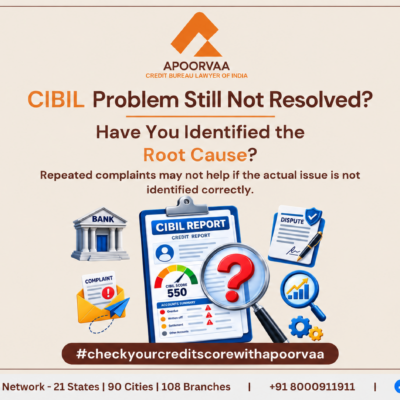




You check your CIBIL Score before applying for a loan.
It shows:
720
or perhaps:
750+
You feel confident.
Then the bank rejects the loan.
The obvious question is:
“If my CIBIL Score is good, why did the bank reject my loan?”
This is where an important misunderstanding about credit scores needs to be cleared.
A good CIBIL Score can improve your chances of getting a loan, but the score alone does not guarantee loan approval.
CIBIL itself explains that when a score is high, the lender can proceed to consider other details before deciding whether the applicant is creditworthy. The final lending decision belongs to the lender.
So instead of looking only at your score, it is important to understand your complete credit profile.
What Is a CIBIL Score?
A CIBIL Score is a three-digit numerical summary of your credit history.
It generally ranges from:
300 to 900
The closer the score is to 900, the better the chances of a loan or credit-card application being considered favourably. CIBIL currently describes a score above 700 as generally good, while its loan guidance commonly refers to 750+ as a strong benchmark.
But this is where borrowers should be careful.
750 is not a guaranteed-loan number.
A good score can strengthen your application.
It cannot force a lender to approve it.
Your CIBIL Score Is Only One Part of Your Credit Profile
Suppose two people both have a CIBIL Score of 725.
Does that mean their credit profiles are identical?
No.
One person may have a long history of properly managed loans.
Another may have an old account containing Write-Off-related information.
Another may have a Settled-related account.
Another may already have significant existing loan obligations.
The number may look similar.
But the credit history behind that number can be different.
CIBIL’s own guidance explains that the report contains much more than the score, including active and inactive loan accounts, repayment history and credit enquiries.
This is why lenders look beyond the number.
A Simple Example: 725 Score but Old Credit Issues
Consider a borrower with a CIBIL Score of around 725.
The borrower thinks:
“My score is reasonably good. Why isn’t the bank approving my loan?”
But suppose the detailed report also contains:
Two old Write-Off-related accounts
and
One Settled-related credit-card account.
The borrower is focused on:
Score = 725
But the lender can review the broader credit report.
Now the application looks different.
The real question is no longer:
“Is 725 a good score?”
It becomes:
“What does the borrower’s complete credit history indicate?”
CIBIL notes that lenders can review payment irregularities, credit-facility status, overdue amounts and other aspects of the report when evaluating an application.
A Higher Score Does Not Automatically Remove an Old Credit Issue
This is another important misconception.
Suppose your score was previously 650.
Over time it increases to 720.
You may think:
“My score has improved, so everything in my old credit history must now be fine.”
That conclusion should not be made from the score alone.
If you are concerned about a particular old loan account, look at what the latest credit report actually reflects about that account.
The score provides a numerical summary.
The report provides the broader credit information behind it.
CIBIL itself distinguishes between the Score and Report and explains that lenders can use the report for a broader view of a person’s credit footprint.
Why Write-Off and Settled Information Can Matter
Banks lend money with the expectation that it will be repaid according to the agreed terms.
So when assessing a new application, a lender may naturally be interested in how previous credit obligations were handled.
This is why historical account information can matter.
For example, if an older account contains Write-Off-related information, a lender may want to understand that account while evaluating the broader profile.
The same can apply to a Settled-related account.
This does not mean:
Write-Off = Every bank will reject the loan
or
Settled = You can never borrow again.
Loan decisions vary by lender and individual circumstances.
The educational point is simpler:
Do not assume that a good score makes all other credit-report information irrelevant.
What About Old DPD?
Borrowers can also become worried when they see historical repayment delays in an old loan account.
Again, context matters.
An old loan that experienced some repayment delays but was subsequently appropriately dealt with should not automatically be viewed in exactly the same way as an account that continues to reflect an unresolved adverse status.
So the objective should not be:
“Find every negative-looking thing and panic.”
Instead:
Understand what your current credit profile actually shows.
Why Loan Approval Depends on More Than CIBIL
There is another important reason why someone with a good CIBIL Score may still be rejected.
Loan approval is not purely a credit-score decision.
CIBIL’s loan-approval guidance notes that lenders may also consider factors such as employment and income, existing obligations, account details, payment history and the relationship between existing EMIs and income.
Depending on the loan and lender, other eligibility requirements may also apply.
Therefore:
Healthy CIBIL Score + Healthy Credit Report
can improve your position.
But neither creates an automatic right to receive a loan.
“My Score Is 750, So the Bank Has to Give Me a Loan”
This is one misunderstanding borrowers should avoid.
A CIBIL Score is an important indicator used during credit assessment.
It is not an instruction to the bank.
CIBIL explicitly states that the decision to lend is solely dependent on the lender; CIBIL itself does not decide whether a loan or credit card should be sanctioned.
Therefore, if your loan is rejected despite a good score, the better response is not:
“My score is 750. The bank cannot reject me.”
Instead, try to understand why the application was unsuccessful.
The reason may relate to your credit profile.
Or it may involve another part of the lender’s eligibility assessment.
Don’t Immediately Apply Everywhere After a Loan Rejection
Another common reaction is:
“This bank rejected me. I’ll apply to five more banks.”
Be careful with this approach.
Loan and credit-card applications can generate credit enquiries, and CIBIL includes lender enquiries in the credit report. It also identifies enquiries as one of the factors used in calculating the score.
This does not mean you should be afraid to apply for genuine credit requirements.
It simply means repeatedly applying without first understanding the earlier rejection may not be the best approach.
If an underlying credit-report issue exists, applying to several lenders does not resolve that issue.
Score Improvement and Credit-Report Correction Are Different
These two concepts are often confused.
Score Improvement
A healthier credit profile can be supported over time by responsible credit behaviour such as timely payments and prudent credit utilisation. CIBIL identifies payment history and utilisation among important score factors.
Credit-Report Issue
A different situation arises when there is a specific problem within the report itself.
For example:
An unknown account
Potentially incorrect account information
An old unresolved account
or another credit-report issue requiring proper examination.
In such situations, focusing only on:
“How do I increase my score?”
may miss the actual concern.
Before Applying for a Loan, Look Beyond the Number
If you are planning a home loan, business loan, personal loan or another important borrowing requirement, knowing your CIBIL Score is useful.
But don’t stop there.
Your credit report contains the history behind that number.
Ask yourself:
Does the report contain an old unresolved account?
Is there any information I don’t understand?
Are there outstanding obligations?
Is there a Write-Off or Settled-related issue?
Is there something that may require further assessment?
You do not need to become a credit-report expert.
The important point is simply:
Don’t assume that 720+ means everything in the report is automatically healthy.
When a Credit-Report Issue Needs More Attention
Sometimes a borrower reviews the report and discovers a complicated historical issue.
Perhaps an old account is still creating concern.
Perhaps the borrower does not understand a particular account status.
Perhaps the information does not match what they expected.
At that stage, repeatedly chasing a higher score may not answer the underlying question.
The relevant issue first needs to be properly understood.
And where the matter is complicated, obtaining professional guidance can help the borrower understand whether there is actually a credit-report issue requiring further attention.
Final Educational Note
A good CIBIL Score matters.
But it is not the complete story.
Remember:
CIBIL Score ≠ Guaranteed Loan
A lender may consider your score, credit report, repayment history, existing liabilities and other eligibility factors before deciding whether to approve an application.
So if your score is 720, 750 or higher and your loan is still rejected, don’t immediately assume that the score is wrong or that the bank must approve the application.
Instead, understand the bigger picture.
Check the score.
Understand the credit report.
Know whether an unresolved credit issue exists.
Then approach your next credit decision with better clarity.
Because when it comes to borrowing, the complete credit profile matters more than one number.
Related Credit Education