


CIBIL Enquiries generally appear in your credit report when a bank or financial institution accesses your report in connection with a loan or credit-card application. If you have applied with several lenders, you may therefore notice multiple enquiries in your CIBIL Report.
This often leads to a common question:
“Can I remove these loan enquiries from my CIBIL Report?”
The answer depends on an important distinction.
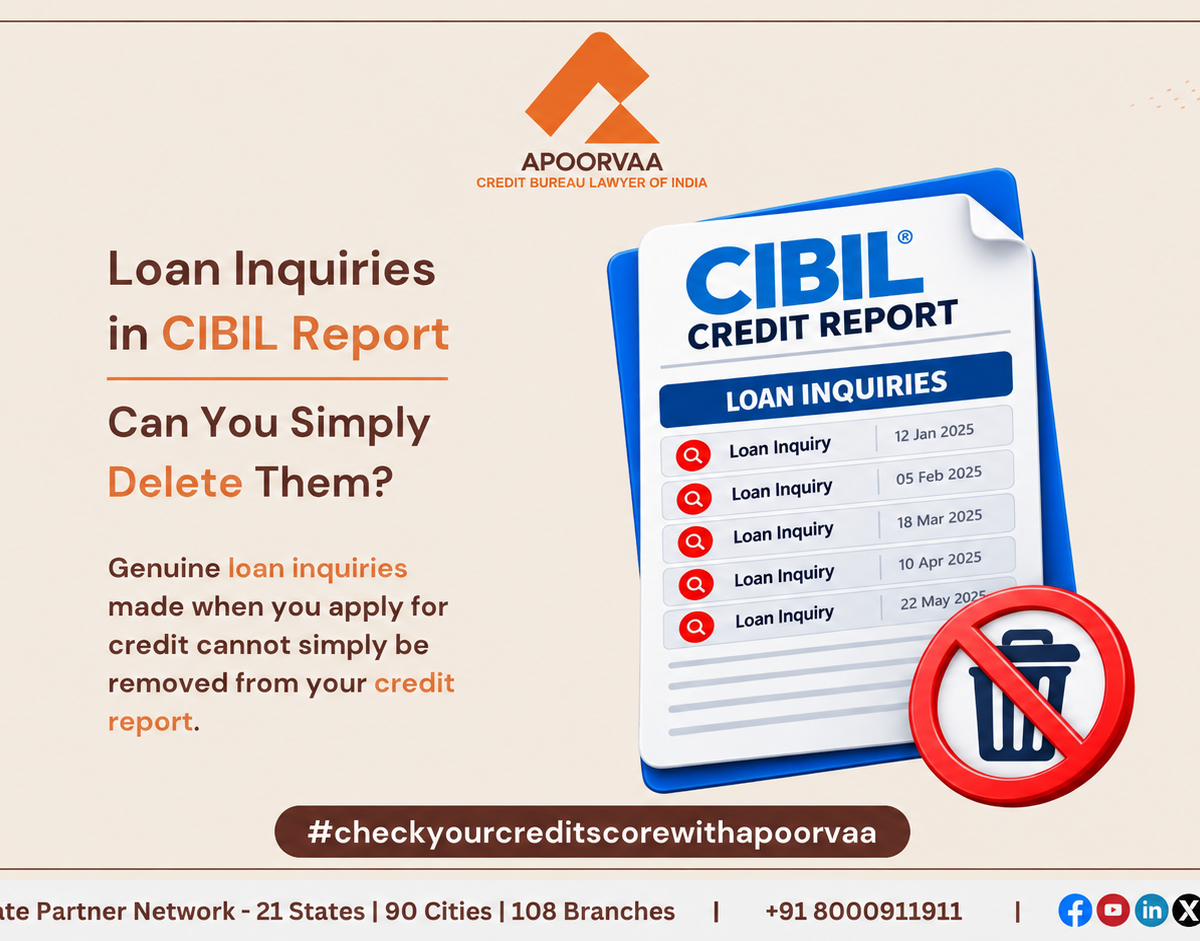
If an enquiry genuinely resulted from a credit application made or authorised by you, it cannot simply be treated as an error because you no longer want it appearing in the report.
However, if you find an enquiry that you genuinely do not recognise or believe is inaccurate, it can be investigated and disputed through the appropriate process. CIBIL specifically allows disputes relating to enquiry inaccuracies and ownership.
Understanding this difference is important before trying to remove any enquiry.
What Is a CIBIL Enquiry?
When you apply for a loan or credit card, the lender may check your credit profile as part of its assessment.
Every time a credit institution requests your CIBIL Report, an enquiry can be created in the report. CIBIL describes the enquiry section as a record of such credit checks; importantly, an enquiry itself does not mean that you actually obtained the loan or credit card.
For example, suppose you apply for a personal loan with three different banks.
All three banks check your CIBIL Report.
Only one bank finally approves your application.
You may still see enquiries relating to the credit checks made during those applications.
Therefore:
Credit Enquiry ≠ Loan Sanction
An enquiry records the credit check associated with an application. It does not by itself establish that the loan was eventually approved or disbursed.
Can Genuine Loan Enquiries Be Deleted?
Suppose you applied for loans with 10 different lenders and all 10 lenders legitimately accessed your CIBIL Report.
Later, you see those 10 enquiries and think:
“Can I keep one enquiry and remove the other nine?”
If those enquiries genuinely resulted from applications made or authorised by you, they should not be disputed simply because you want fewer enquiries in your report.
The fact that:
- The loan was rejected,
- You ultimately borrowed from another lender,
- You changed your mind,
- Or you now have several enquiries
does not by itself make a genuine enquiry inaccurate.
The purpose of credit-report correction is to address inaccurate information, not to remove accurate information simply because it is undesirable.
What If the Loan Was Rejected?
This is another common misunderstanding.
Suppose you apply for a ₹5 lakh personal loan.
The lender checks your credit report but later rejects the application.
You might think:
“Loan mila hi nahi, toh enquiry remove ho jaani chahiye.”
But the enquiry represents the fact that the lender accessed your credit information during the application process.
The final outcome of the application is a separate matter.
Therefore, a genuine enquiry does not automatically become incorrect merely because the loan was never sanctioned.
What If You Don’t Recognise an Enquiry?
This situation is different.
Imagine checking your CIBIL Report and finding an enquiry from a lender that you do not remember approaching.
First, don’t immediately conclude that someone has misused your identity.
Check whether you recently:
- Applied through a loan marketplace
- Approached a DSA
- Used a fintech lending platform
- Applied for a credit card online
- Used a service involving a lending partner
CIBIL itself notes that unfamiliar enquiries can sometimes arise where a consumer used a third-party marketplace partnered with banks or financial institutions.
If, after checking, you genuinely cannot connect the enquiry with any application or authorisation, investigate it further.
You can contact the concerned lender and raise an enquiry-related dispute through CIBIL where appropriate.
Genuine Enquiry vs Incorrect Enquiry
This is the simplest way to understand the issue.
Genuine Enquiry
You applied for or authorised an application for credit.
The lender accessed your report.
The enquiry accurately reflects that credit application.
It should not be disputed merely because you want it removed.
Incorrect or Unrecognised Enquiry
You genuinely do not recognise the credit application or believe that the enquiry information is inaccurate.
It should be verified and may be disputed where appropriate.
This distinction prevents genuine credit history from being confused with a credit-reporting error.
Can CIBIL Directly Delete an Enquiry?
CIBIL provides a dispute mechanism for inaccuracies, enquiries and duplicate enquiries. However, it also states that it cannot independently delete or modify records in a credit report without confirmation from the relevant credit institution.
Therefore, raising a dispute does not mean that the enquiry will automatically disappear.
The information needs to be verified with the concerned credit institution.
If the lender confirms that the enquiry is accurate, it should not be expected to be removed simply because a dispute was raised.
If the information is found to be incorrect, the appropriate correction can then be processed.
Can Multiple Loan Enquiries Affect Your Credit Profile?
Frequent applications for new credit can become relevant to your credit profile.
CIBIL advises consumers to apply for new credit in moderation rather than continuously seeking excessive credit.
This does not mean you should become afraid of making a genuine loan application.
The concern is unnecessary or repeated applications.
For example, if one bank rejects your personal-loan application and you immediately apply with eight more lenders, multiple additional enquiries may be generated.
Instead, first understand:
- Why the previous application did not proceed
- Your current credit profile
- Existing EMI obligations
- Repayment history
- Income eligibility
- Current outstanding balances
Then decide whether another application is appropriate.
Does Every Enquiry Reduce Your CIBIL Score by a Fixed Number of Points?
No fixed number should be assumed.
You may hear claims such as:
“Every enquiry reduces CIBIL by 5 points.”
or
“Ten enquiries mean your score will fall by 50 points.”
Credit scoring should not be understood through such a simple fixed-point formula.
CIBIL states that credit enquiries generally have a minimal impact on the score, while repeated applications can form part of the overall credit profile.
Therefore, the better approach is not to calculate an assumed number of points for every enquiry.
Focus instead on avoiding unnecessary credit applications and maintaining responsible overall credit behaviour.
Checking Your Own Credit Report Is Different
People sometimes avoid checking their own credit report because they fear that doing so will create another loan enquiry.
A lender accessing your credit report in connection with a credit application is different from reviewing your own credit information for monitoring purposes.
Regularly reviewing your report can actually help you identify unfamiliar enquiries, accounts or other inaccuracies. CIBIL itself recommends monitoring your credit report and provides guidance for investigating enquiries that consumers do not recognise.
What Should You Do If You Have Too Many Genuine Enquiries?
If several genuine CIBIL Enquiries already appear in your report, don’t panic and don’t look for shortcuts to delete them.
Instead:
Stop making unnecessary new credit applications.
Review your complete credit profile before applying again.
Understand why previous applications may not have proceeded.
Continue making existing loan and credit-card payments responsibly.
And allow your credit profile to develop through appropriate financial behaviour.
Trying to artificially remove accurate information is not a substitute for responsible credit management.
Simple Checklist for Reviewing CIBIL Enquiries
When checking the Enquiries section of your report:
- Check the lender name.
- Check the enquiry date.
- Review the credit type and amount, where available.
- Match enquiries with applications you remember making.
- Consider applications made through DSAs or online platforms.
- Identify enquiries you genuinely do not recognise.
- Verify unfamiliar enquiries with the concerned institution.
- Dispute genuinely inaccurate information where appropriate.
- Don’t dispute genuine enquiries simply to reduce their number.
- Avoid unnecessary credit applications going forward.
Key Takeaway
CIBIL Enquiries are a normal part of the credit-application process.
If you genuinely applied for credit and the lender accessed your report, that enquiry cannot simply be treated as incorrect because you later want it removed.
At the same time, an enquiry that you genuinely do not recognise should not be ignored.
The correct approach is:
Recognise the enquiry → Verify unfamiliar information → Dispute genuine inaccuracies → Avoid unnecessary future applications.
Understanding the difference between accurate credit history and incorrect credit information is far more important than trying to make every unwanted entry disappear.
Educational Note
This article is intended for credit awareness and educational purposes. Credit-report information should be evaluated according to the facts of each individual case. Where an enquiry appears inaccurate or unauthorised, consumers should verify it with the concerned credit institution and use the appropriate credit-bureau dispute process where required.