



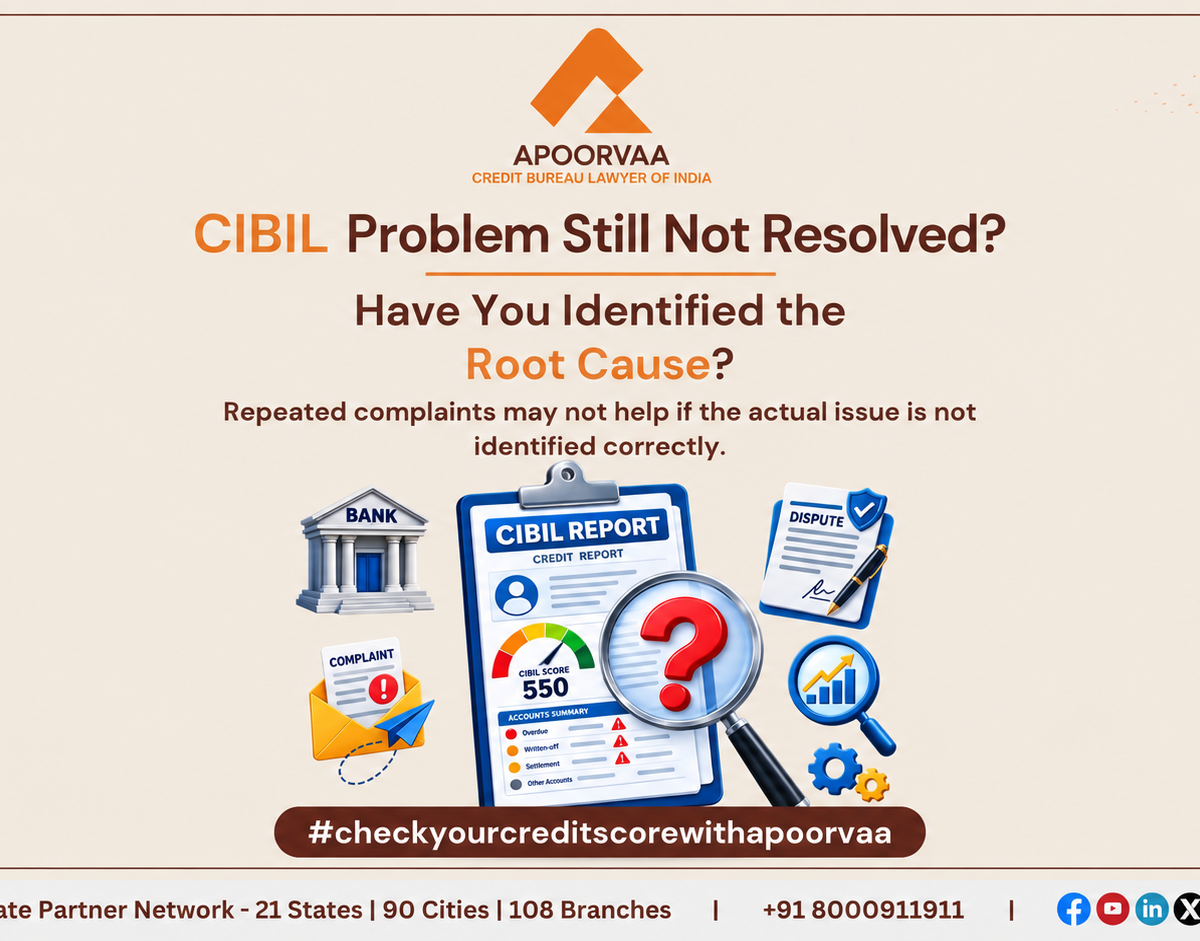
You have contacted the bank.
You have raised a dispute.
You have sent emails.
Perhaps you have even approached different professionals.
Months have passed, but the same problem is still appearing in your credit report.
At this stage, it is natural to think:
“Why is nobody able to resolve my CIBIL problem?”
Sometimes, however, the issue may not be a lack of effort.
The more important question may be:
Has the actual problem been identified correctly?
When the root cause of a credit-report issue is misunderstood, repeatedly taking action against the visible problem may not necessarily resolve what is happening underneath.
A Credit-Report Problem Can Have More Than One Cause
When people look at their credit reports, they naturally focus on whatever appears wrong.
For example:
“This loan is not mine.”
“This balance is incorrect.”
“Why is this account still showing?”
“Why is my CIBIL Score still low?”
These are valid concerns.
But the same visible problem can sometimes require different explanations.
For instance, an unfamiliar account may raise questions about account ownership.
In another situation, the customer may notice inconsistencies in personal information.
A different case may involve account information that requires verification with the lender.
TransUnion CIBIL allows consumers to dispute inaccuracies across sections including Personal, Contact, Employment, Account Details and Enquiry. It also specifically allows account disputes relating to inaccuracies, ownership and duplicate information.
Therefore, understanding what type of problem you actually have is important before deciding what should happen next.
The Visible Problem May Not Always Be the Root Cause
Imagine that several loans appear in your credit report and you believe they do not belong to you.
Naturally, your attention goes immediately to those loans.
You may think:
“These accounts are the problem. I just need them removed.”
But there may be another question worth asking:
Why are these accounts appearing against this credit profile?
That question changes the way the problem is viewed.
Instead of focusing only on the visible entries, it encourages a broader examination of the credit information.
This is what we mean by identifying the root cause.
The account appearing in the report may be the visible problem.
Understanding why it is appearing may be equally important.
Personal Information in Your Credit Report Also Matters
Many people assume that a credit report is only about loans and credit cards.
It also contains personal information associated with the credit profile.
This can include information such as:
Name
Date of birth
Identification information
Addresses
and other details reported within the credit ecosystem.
CIBIL specifically recognises inaccuracies in personal information as disputable. Its guidance also identifies incorrect profile information such as name, date of birth and identification details as information consumers should look for when reviewing their reports.
This does not mean that every spelling difference or personal-data discrepancy automatically causes someone else’s loan to appear.
But if your report contains unusual account information and personal details that appear inconsistent, the complete situation deserves proper examination.
Why Repeated CIBIL Disputes May Not Always Solve the Problem
A dispute is an important mechanism when information in a credit report appears inaccurate.
But raising a dispute is not the same as automatically getting information changed.
CIBIL explains that it cannot delete or modify lender-reported records without confirmation from the respective credit institution. The dispute is taken up with the concerned bank or credit institution for verification.
This distinction matters.
Suppose you repeatedly dispute the same account.
If the actual issue involves something different from what is being challenged, repeating the same dispute may not address the root cause.
Therefore, when a dispute has not produced the expected result, don’t think only:
“Where can I complain next?”
Also ask:
“Am I challenging the correct issue?”
More Complaints Do Not Automatically Mean a Better Solution
When an issue remains unresolved, frustration naturally leads to escalation.
A customer may contact:
The bank
The credit bureau
Customer-care teams
Grievance departments
Other professionals
or even use social media to highlight the problem.
There is nothing inherently wrong with escalation when it is appropriate.
The important question is whether the problem being escalated has been identified correctly.
If the diagnosis is wrong, escalating the same assumption through five different channels may still leave the original issue unresolved.
This is why understanding should come before repeated action.
A Simple Example
Consider a customer whose credit report contains several unfamiliar loan accounts.
The customer has already raised disputes against those accounts.
But the problem continues.
During a broader examination, inconsistencies are also noticed in some of the personal identification information associated with the profile.
At this point, the situation deserves to be looked at differently.
Instead of asking only:
“How do we remove these loans?”
another question becomes relevant:
“Is there a broader credit-data issue that needs to be understood?”
This does not automatically establish what caused the unfamiliar accounts.
But it shows why proper diagnosis should come before assuming the solution.
Why Different Credit Problems Need Different Approaches
Consider these situations:
Situation A: A genuine old loan remains unpaid.
Situation B: A loan appears that the customer does not recognise.
Situation C: Personal information appears inaccurate.
Situation D: An account was previously addressed, but the latest report does not reflect what the customer expected.
All four customers may say:
“My CIBIL Report is wrong.”
But they do not necessarily have the same problem.
And therefore, they should not automatically receive the same solution.
This is one of the most important lessons in credit-report awareness:
The nature of the problem determines the appropriate response.
Why a Second Opinion Can Sometimes Help
Suppose you have already spent several months trying to resolve an issue.
You have taken professional assistance.
You have raised complaints.
You have followed the suggested process.
But the problem still remains—and you still do not clearly understand why.
In such circumstances, taking a second opinion can be sensible.
A second opinion does not mean that the first professional was necessarily wrong.
A bank official, advocate, Chartered Accountant, financial professional or another adviser may have acted based on the information available and their professional understanding.
But complicated problems can sometimes benefit from a fresh perspective.
The purpose of the second opinion should be:
“Can someone else look at the same information and help me understand whether the problem has been identified correctly?”
A Second Opinion Is Not About Finding the Answer You Want
There is an important caution here.
Taking a second opinion should not mean approaching different people until somebody finally promises:
“Yes, I can remove everything.”
That defeats the purpose.
A useful second opinion may actually confirm that the earlier professional’s assessment was correct.
Or it may identify another issue that deserves examination.
Either result can be valuable because the objective is clarity, not simply finding a more attractive answer.
When Should You Consider Another Opinion?
A second opinion may be worth considering when a credit-report problem has continued for a significant period despite repeated efforts.
It can be particularly useful when:
- You still don’t understand why the problem exists
- Several disputes have not resolved the issue
- Different professionals are giving very different explanations
- Multiple unfamiliar accounts are appearing
- Personal information in the report appears inconsistent
- You have already spent considerable time or money without gaining clarity
- An important loan or financial requirement continues to be affected
At that stage, another complaint may not necessarily be the first thing you need.
Another perspective may be more valuable.
Don’t Let Urgency Replace Understanding
Credit-report problems become particularly stressful when they interfere with an important financial requirement.
Perhaps you need:
A home loan
Business funding
Vehicle finance
Loan against property
or another credit facility.
When the loan is urgent, customers naturally search for the fastest possible solution.
But urgency can sometimes encourage people to take repeated actions without first understanding the problem.
If you have already spent months trying different approaches, consider whether it is time to stop asking:
“What else can I do?”
and start asking:
“What exactly is wrong?”
That may be the more important question.
Final Educational Note
When a CIBIL problem is not resolved, repeated complaints are not always the answer.
The first objective should be to understand whether the actual issue has been identified correctly.
An unknown account may require one kind of examination.
Incorrect personal information may require another.
An account-information discrepancy may involve another issue.
And genuine negative credit information should not automatically be treated as incorrect simply because it is affecting the customer’s credit profile.
CIBIL’s own dispute framework distinguishes among personal information, account information, ownership, enquiries and other report sections.
That itself reinforces an important principle:
Different credit-report problems require different assessments.
So if you have already tried several routes without success, don’t simply repeat the same action.
Consider whether the root cause needs to be understood again.
And when necessary, obtaining a second informed opinion can help you decide what the appropriate next direction may be.
Related Credit Education